Description of the LPR Camera System
Boonsboro Police Department Chief Dave Rizer
BOONSBORO, MARYLAND
Follow the documented history of Boonsboro's license plate reader camera system, review the underlying Town records, and learn about the October 5 public meeting.
PUBLIC OPEN MEETING
The Mayor & Council and the Boonsboro Police Department are hosting a special meeting to give the public a chance to ask questions and learn more about the LPR camera system. Comments are allowed with a 3-minute limit; sign in to speak.
Download meeting flyer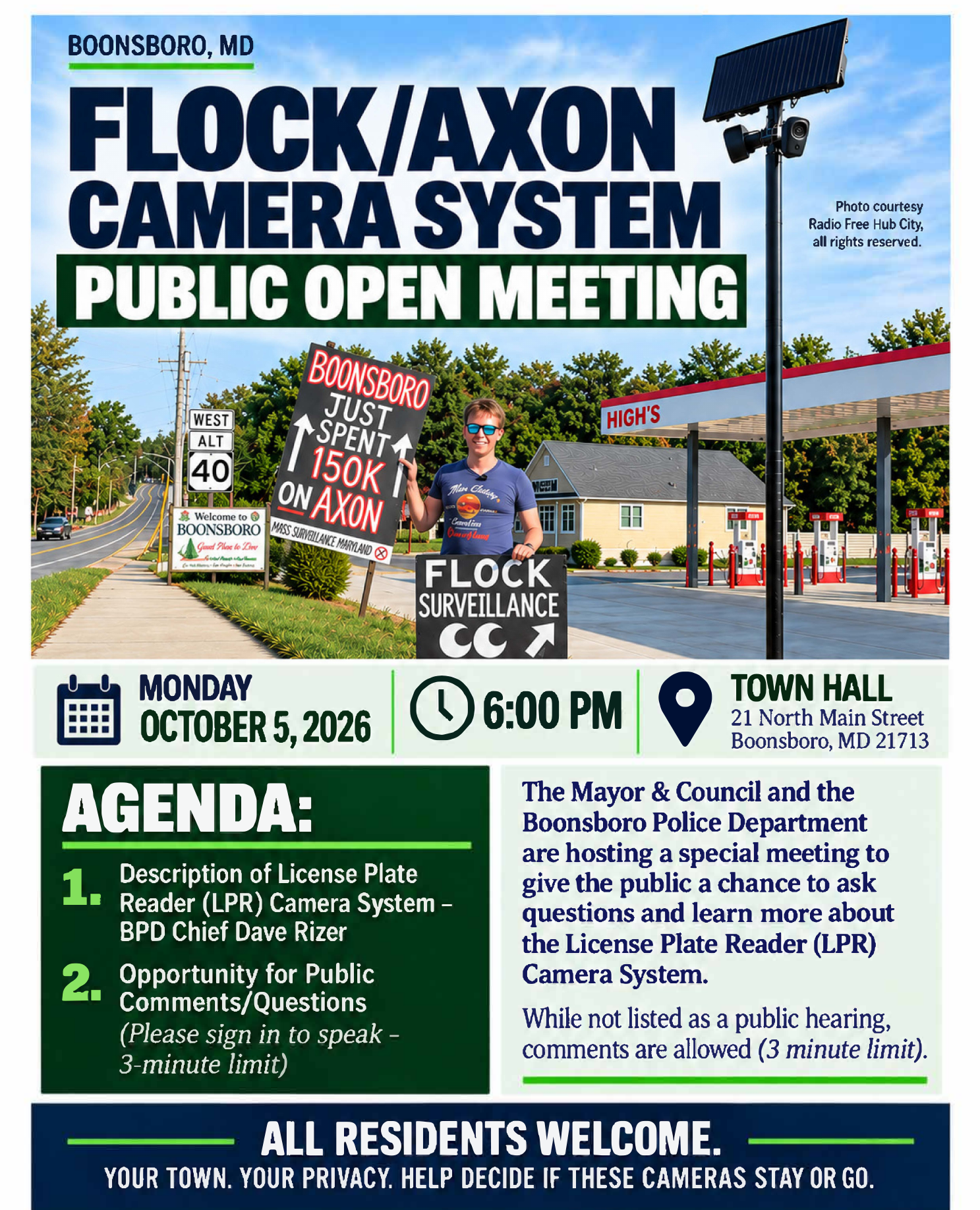
OCTOBER 5
Boonsboro Police Department Chief Dave Rizer
Please sign in to speak. Three-minute limit.
PRIMARY-SOURCE TIMELINE
Each entry includes links to the Town record so readers can review the source for themselves.
Chief Dave Rizer reported on a June 4 meeting with the Hagerstown Police Department about its camera program and said Boonsboro would need seven solar-powered front license-plate readers for full Town coverage.
Chief Rizer presented the Flock proposal during the Police Department report. The proposal contemplated 14 cameras, and Council approved the purchase. The Flock purchase was not separately identified on the published meeting agenda.
The Town reported that installation of the Flock cameras was expected to begin September 16.
Chief Rizer responded to concerns about the seven new LPR cameras and discussed access to the data, restrictions on its release, and a written Police Department policy.
Council discussed whether to table the proposed change in LPR vendors from Flock to Axon or proceed with a vote. Assistant Mayor Tony Nally, who was presiding, said he was willing to table the item to allow for additional public input. Police Chief Dave Rizer indicated that he did not oppose delaying action.
Council ultimately proceeded with the vote. Marilee Kerns moved to approve changing the Town's LPR camera vendor from Flock to Axon, Ray Hanson seconded the motion, and the motion carried.
Following Council's August decision to proceed with the Axon vendor change, residents asked Council to hold a dedicated public discussion about the Town's LPR camera system.
Travis Riner and Andy Pugh submitted emailed comments requesting a broader public discussion. David Bell and Brandon Thompson spoke during public comments about the opportunity for additional public input that Council had discussed before the August vote.
The Mayor & Council and Boonsboro Police Department will hold a meeting devoted to the License Plate Reader camera system. Police Chief Dave Rizer will describe the system, followed by an opportunity for public comments and questions.
Monday, October 5, 2026 · 6:00 PM
Town Hall · 21 North Main Street, Boonsboro
Public comments are permitted with a three-minute limit. Residents wishing to speak are asked to sign in.
HOW THE SYSTEM WORKS
Boonsboro's August 10 informational letter says its fixed Axon license plate reader (LPR) cameras will photograph the rear of passing vehicles and capture license plates and vehicle characteristics such as color, make and body type. The system records a vehicle when it passes a specific camera location and checks plates against law-enforcement hotlists, including alerts involving stolen vehicles or plates and missing or wanted persons.
According to the Town's description, the cameras do not identify drivers or occupants, use facial recognition, record audio or vehicle speed, or provide continuous GPS-style tracking. Boonsboro says captured data will be retained for 30 days and searches must be for legitimate law-enforcement purposes.
Town informational letter →FOR THE PUBLIC DISCUSSION
What information is collected, how long is it retained, and who can access or share it?
What benefits justify spending approximately $90,000 of the Axon contract on the FLOCK/AXON camera system?
What are the year-to-date statistics on use and solve rate?
In cases where LPR data contributed, what role did it play, and could the same result have been achieved through standard investigative methods?
What privacy safeguards, oversight and audit procedures are in place?
How will the Town measure whether the system is effective and worth the cost and privacy tradeoffs?
SOURCE LIBRARY
ABOUT THIS SITE
DeFlock Boonsboro is a community information website and is not affiliated with or operated by the Town of Boonsboro. Timeline summaries are paired with primary-source links so readers can review the underlying records directly.
Peter Anderson, 19709 Roxbury Road, supported law enforcement use of cameras and expressed confidence in Chief Rizer and the Police Department’s responsible use of technology. He described thefts experienced as a Boonsboro business owner and said cameras helped solve them.
Travis Riner, 141 Monument, opposed broad public surveillance and raised concerns about LPR systems collecting information on law-abiding residents without individualized suspicion. He acknowledged potential crime-solving and deterrence benefits but said he would rather see Town resources invested elsewhere, including deteriorating infrastructure.
Matthew Agresti, 105 Tiger Way, raised questions about Axon, data ownership, service lock-in, user agreements, model training, future uses and cybersecurity. He also asked about subscription costs after the five-year term and Axon’s ability to access and use Town data.
David Bell, 22 St. Paul Street, requested a public hearing on the broader use of surveillance technology and asked about existing cameras, retention, access, monitoring and the status of the Axon agreement. He supported providing police with tools to keep the community safe while arguing that residents should have an opportunity to discuss the role of surveillance technology and its safeguards before additional LPR action.
Andy Pugh, 310 Chieftan, opposed expanded surveillance on constitutional and privacy grounds and questioned the original Flock approval process, the need for advanced LPR systems in Boonsboro and whether Council fully understood the original purchase.
Hugh O’Neill, 327 N. Main St., raised concerns about Police Department spending, staffing visibility, vehicle purchases and switching camera vendors after approximately one year. He described himself as relatively neutral on LPR cameras and supported greater resident involvement in decisions about Town surveillance.
Alexandra Swann, 6134 Rohrersville Rd., raised concerns about daily travel past cameras, cybersecurity, the relevance of LPRs to particular crimes and whether the level of surveillance was proportional to Boonsboro’s crime level.
Daniel Porfirio, 202 Burton Way, opposed the use of Flock and Axon cameras, arguing that Boonsboro did not need privatized surveillance and raising concerns about corporate use of data, privacy and whether comparable nearby municipalities use similar systems.